Your Notes Are a Receipt, Not a Memory — Why Transcribing Everything Teaches You Almost Nothing
Photo: person typing notes on laptop with online lecture video open on screen, via www.clipartbest.com
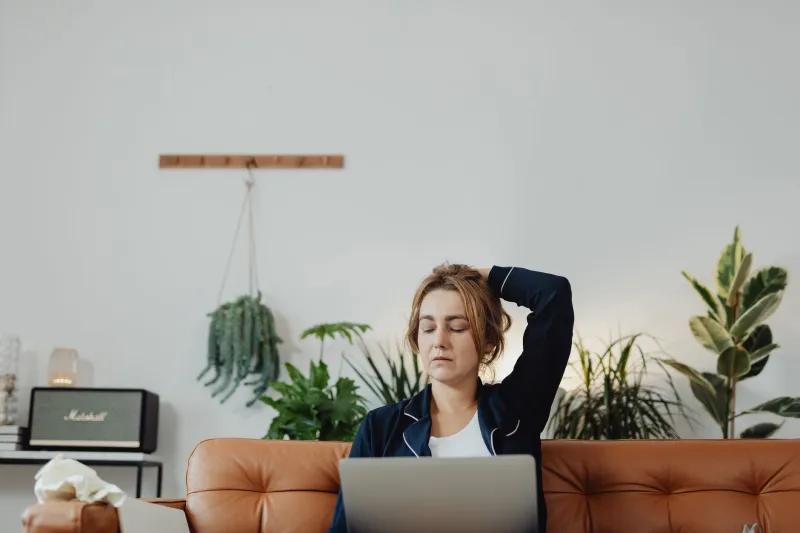
It's 8:45 on a Tuesday night. You've got a recorded lecture running in one tab, a slide deck in another, and a document you're typing into with the focused urgency of someone transcribing a court proceeding. Ninety minutes later you have four pages of notes. Two weeks later, you couldn't explain the main idea to a friend if they offered you money.
That experience is common enough to feel like a personal flaw. It isn't. It's the predictable result of how memory works — and online learning happens to be unusually good at triggering it.
Storing something is not the same as knowing it
Researchers who study learning draw a hard line between two jobs we tend to blur together: where information lives, and whether you can pull it out of your own head. Writing something down completes the first job. You've built an external store — a document, a highlight, a saved bookmark, a folder of PDFs you will definitely revisit.
Retrieval is the second job, and it's the one that actually builds durable memory. Every time you drag a fact back out of your brain without checking the file, you strengthen the route to it. Every time you skip that step because the answer is sitting right there, the route stays thin.
Psychologists call the shortcut cognitive offloading. It's not laziness — it's efficiency. Your brain is a ruthless economist and will outsource anything it believes it can find later. The catch is that it also stops maintaining the internal copy. You didn't fail to remember the lecture. You successfully convinced your brain it didn't need to.
Why the keyboard nudges you toward transcription
A well-known 2014 study by Pam Mueller and Daniel Oppenheimer found that students who typed notes tended to capture lectures word for word and performed worse on conceptual questions than students writing by hand. That finding got repeated so often it hardened into folklore, and later researchers have complicated it — some replications find no difference, and handwriting has its own limits.
The takeaway worth keeping isn't 'laptops bad.' It's that verbatim capture is the low-effort path, and keyboards make it frictionless. When your goal becomes completeness, you stop doing the mental work of deciding what matters, how it connects to what you already know, and where your understanding breaks down. Those decisions are the learning. The transcript is just the byproduct.
Online courses are a note-taking trap by design
In-person classes have built-in friction that online programs have removed. There's no recording to fall back on, no slide deck posted an hour later, no chat log to skim. Everything is happening once, in the room, at speed — which forces your brain to encode in real time.
Online, almost everything is permanent. Lectures are archived. Transcripts are auto-generated. Slides stay in the learning management system until the course closes. That permanence is a gift for accessibility and a hazard for memory, because it whispers the same message over and over: don't worry, it'll be there.
Self-paced courses make it worse. Nobody checks whether you can reproduce an idea from memory. Completion bars measure clicks, not comprehension. You can finish a module with an immaculate notebook and a brain that never had to hold anything.
The fluency illusion, in a nutshell
There's a specific feeling that trips people up: the warm sense of familiarity when you re-read your own notes. It feels like knowledge. Usually it's recognition.
Recognition is 'I've seen this before.' Recall is 'I can produce this from nothing.' Only one of them shows up when you're on a timed quiz, in a job interview, or trying to apply a concept to a situation your instructor never described. Highlighting and re-reading are the two most popular study methods in America and also two of the weakest, precisely because they generate that cozy feeling without demanding any output.
Notes should be an argument, not an archive
The fix isn't fewer notes. It's notes that do a different job.
- Write in your own words, always. If you can't paraphrase a sentence, you don't have it yet. Paraphrasing is the encoding.
- Summarize each section in one line. Force yourself to name the single point rather than preserving all of them.
- Record your confusion, not just the content. A note that says 'I don't see why this step follows from the last one' is worth more than three bullet points of definitions.
- Turn headings into questions. Writing 'What breaks if you remove this variable?' creates something to retrieve. Writing 'Variable types' creates something to skim.
- Prune aggressively. A five-page summary you actually review beats thirty pages you never open.
Closed-book recall: the part almost everyone skips
Once a week, close everything. Take a blank page and write down everything you can remember about the module — concepts, structure, examples, points of confusion. Then open your notes and see what you missed.
It will feel bad. That's the mechanism. The discomfort of a struggling retrieval attempt is the signal that your brain is doing the work that builds memory, and the gaps you find are a map of what to review next. It's also the single most efficient diagnostic tool available to a self-directed learner, because nobody else is going to quiz you.
Pair it with a light spaced schedule: revisit the material roughly a day later, a few days after that, and again in about two weeks. Three short retrieval sessions beat one long review every time.
A one-week reset
Pick one course you're currently taking. For the next module, do three things: take notes only in your own words, end each section with a question you can't yet answer, and do a ten-minute blank-page dump before you open the next lesson. Keep your old notes for reference, but stop treating them as the deliverable.
The goal was never a beautiful document. It was a brain that could walk into a room without it.